Workforce training tied to employment is one of the most reliable levers we have for reducing recidivism. VR training makes that possible inside facilities where physical labs, equipment, and instructors often can't reach. The research is consistent: people who build job-ready skills before release return to custody at lower rates and find work faster once they're home. Here's what the evidence shows, and where the honest gaps still are.
The Number That Should Reframe the Conversation
Most conversations about reducing recidivism circle around supervision, sentencing, and programming. They tend to skip the simplest question: when someone walks out the door, do they have a skill an employer actually wants?
The most rigorous evidence comes from a RAND meta-analysis funded under the Second Chance Act and conducted with the U.S. Departments of Justice and Education. The findings, drawn from the highest-quality studies available:
With roughly four in ten people returning to prison within three years of release, a 43% reduction in those odds isn't a marginal improvement — it's a different trajectory for a person, a family, and a community.
Why Vocational Training Is So Hard To Deliver Inside Correctional Facilities
Here's the part that rarely makes it into the policy conversation: even where everyone agrees skill-building works, delivering it inside a facility is extraordinarily difficult. Real vocational training needs equipment, space, qualified instructors, and a setting that can accommodate security requirements. A welding lab, a diesel bay, a working kitchen: these are expensive, hard to staff, and hard to secure. RAND's own data shows that even though most states offer some correctional education, no more than half of incarcerated people receive any instruction at all.
That's not a failure of will. It's a failure of logistics — and it's the gap immersive training was built to close.
What Immersive Job Training Changes for Workforce and Reentry Programs
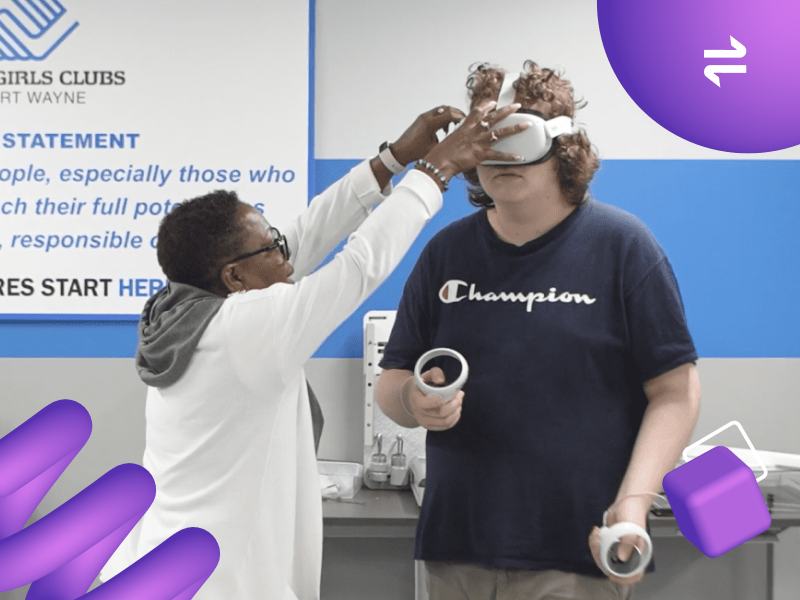
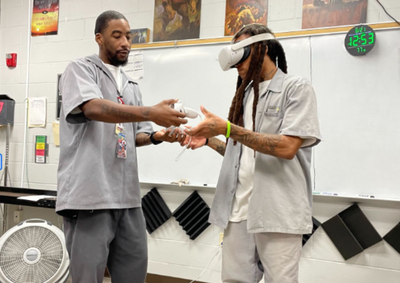
VR removes the physical barrier. A single headset can put someone inside a simulated job site (operating equipment, following a real workflow, making decisions and getting immediate feedback) without the lab, the raw materials, or the safety risks that make hands-on training so hard to deliver behind the wall.
But the mechanism that matters most isn't the hardware. It's what happens in the learner. Skill built through rehearsal — actually doing the task, repeatedly, with feedback — transfers to the real job in a way that watching or reading simply doesn't. The skill follows the person home.
There's also something quieter happening. Practicing a future is an act of agency. For someone preparing to reenter a world that often expects them to fail, the experience of building a real, marketable skill, and knowing it, changes how they walk toward the door.
Transfr's Early Results: VR Training Outcomes in Reentry Programs
The research base for correctional education broadly is strong and decades deep. The research base for immersive correctional training specifically is younger, and we should be honest about that. Here's what we're seeing so far, facility by facility:
- Scott County Jail construction cohort: Run with Ivy Tech Community College, the local workforce board, and the Carpenters Union, this program led to 18 participants recruited directly by the union within its first six months, each completing OSHA-10 certification.
- Leon County Detention Facility: Across two cohorts, 17 incarcerated learners graduated and 11 were released after completing 120 hours of blended training with VR at its core. Many participants exceeded required training hours, signaling strong engagement and readiness for reentry.
These are early, facility-level signals — not controlled studies — but they point in the same direction as forty years of correctional-education research: give people a real skill, and you change the odds.
Where the Evidence on VR Job Training and Recidivism Still Has Gaps
Credibility in this field is earned by naming the limits, not papering over them.
RAND itself was careful here: when the analysis was restricted to only the highest-quality studies, the employment finding became harder to confirm with statistical certainty, even as the recidivism finding held. Long-term, longitudinal data on VR-based training specifically (tracking the same learners for years after release) is still being built. We don't yet have decades of it, because the technology hasn't existed for decades.
What we do have is a strong theoretical foundation, a deep evidence base for the underlying principle, and a growing set of real-world outcomes. We treat the gaps as a research agenda, not a marketing problem.
What a Working Reentry-to-Employment Model Looks Like
The facilities seeing the most traction aren't treating immersive training as a gadget. They're building it into a sequence: assess where someone is, build a transferable skill through repeated rehearsal, connect that skill to a credential or a specific local employer's need, and hand the person off to reentry partners who can turn the skill into a job.
That last handoff is everything. Training inside the wall only reduces recidivism if it connects to employment outside it — which is why the most effective models think about the whole ecosystem, from the facility to employers, workforce agencies, community organizations, and reentry partners who help remove barriers and turn skills into careers. Sustainable reentry depends on more than a job skill alone; it requires coordinated support that addresses the practical realities of housing, transportation, mentorship, and employment. At the same time, employers across the skilled trades are facing historic workforce shortages, making justice-impacted individuals one of the nation's largest untapped talent pools — a rare opportunity to help businesses fill critical roles while connecting people returning from incarceration to family-sustaining careers.
The Bottom Line on VR Job Training and Recidivism
We can keep talking about recidivism as a problem to be managed. Or we can treat it as what it actually is on the ground: a person, a skill, and a door.
The evidence is clear about which approach works. The question now is how fast we're willing to put real, job-ready training within reach of the people who need it most — including the ones in the places that have always been hardest to reach.
Want to bring this kind of training to your reentry or workforce program? Talk to our team.