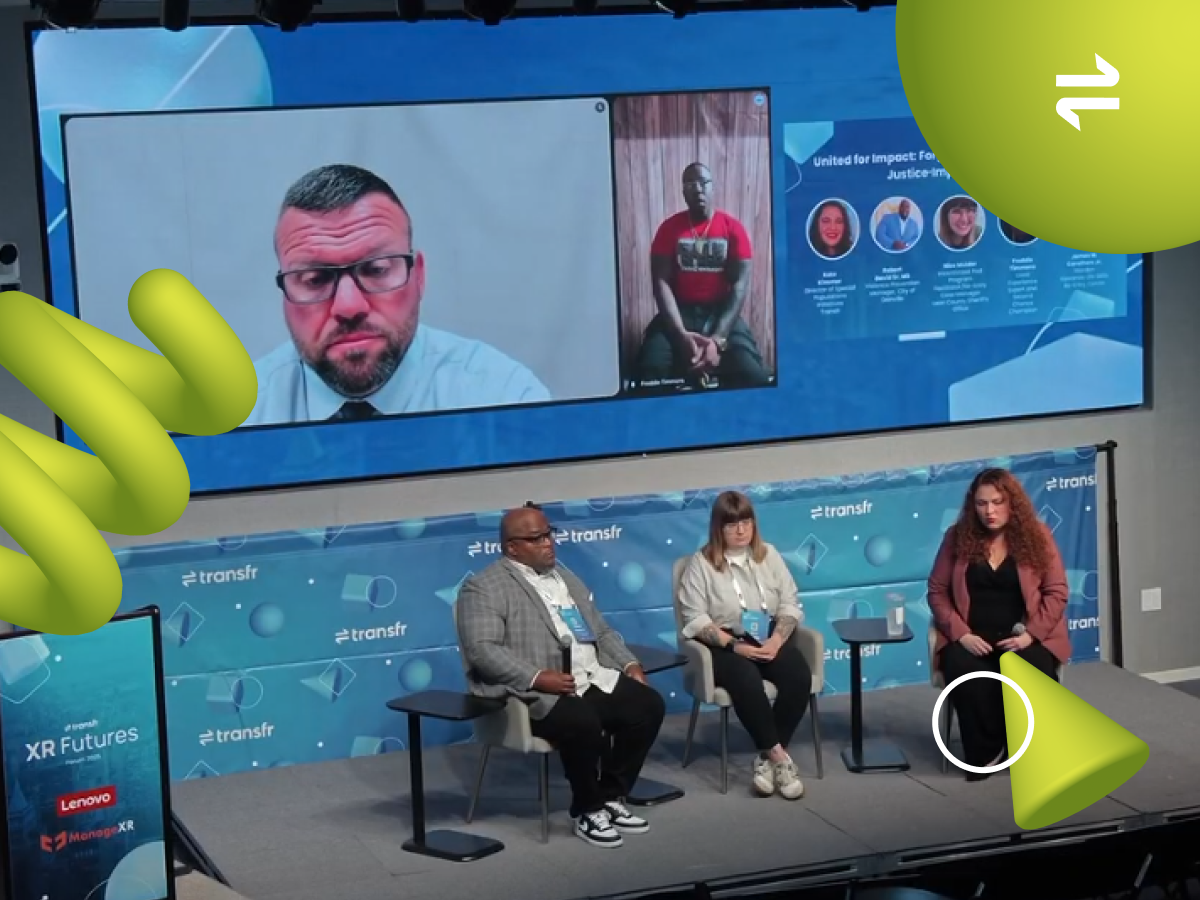
At this year's XR Futures Forum, I had the privilege of moderating a panel that fundamentally challenged how we frame intervention and transformation, and what we really mean when we talk about "second chances."
I brought together Freddie Timmons, who spent 28 years in prison starting at age 16; Robert David, Violence Prevention Manager for the City of Danville; Nico Mulder, who runs programming at Leon County Detention Facility; and Warden James Carothers of Kewanee Life Skills Reentry Center in Illinois.
What emerged wasn't a sales pitch or a program showcase. It was a masterclass in understanding complex human ecosystems—and a roadmap for anyone serious about creating sustainable change in individuals and communities impacted by violence, poverty, and incarceration.
The Ecosystem We Don't Talk About
Robert David started with something that made the room go quiet: "Gangs are an ecosystem. If you limit resources from any group of people and don't provide them access and create barriers, they will create their own ecosystem."
He wasn't justifying gang involvement. He was naming a truth that those of us in this work need to sit with: gangs provide what Maslow says humans need—shelter, belonging, identity, even self-actualization. “When a 14-year-old joins a gang, they get all of that immediately. Maybe not in ways we deem appropriate, but if you're choosing between a trap house with people who know you and the street? The choice is clear.”
The Barriers We Create Without Knowing
As Robert explains, without centering the voices with lived experience, programs and policies are often doomed to fail the very populations they intend to serve and empower. They unknowingly create barriers to both program access and success.
"You got a kid in Brooklyn, and you tell him you've got a training facility here in Manhattan and you're going to pay them $1,000 a week, and then they don't show up—what do we do? We call them lazy."
Robert paused. "They're not lazy, they're restricted."
Gang members can't cross certain territories without risking their lives. They don't ride public transportation because they become targets. A young person might want job training desperately, but literally cannot access it without putting themselves in danger.
We build programs. We fund initiatives. We create opportunities. And then we blame the very people we're trying to serve when they don't show up, without ever asking: What are we not seeing? What barriers exist that we're not accounting for?
Robert's solution in Danville was simple but profound: create a neutral space where everyone knows they can come safely. Both sides of gang territories use it. The community respects it. And suddenly, the "unreachable" youth are reachable—not because they changed, but because we met them where they actually are.
Watch The Webinar On-Demand
This blog is a recap of the 2025 XR Futures Conference. While you may have missed the in-person event, you can watch the recorded sessions on demand.
The Identity Split We Ignore
Robert said something else that has stayed with me: "When you're 14 years old trying to provide for your younger sibling... if you go out and rob someone in the street or break into a house and you feed your little sister, you're considered a man. But when you come to school back in the eighth grade, they talk to you like you're a child."
Think about that psychological whiplash. In one ecosystem, you're an adult with adult responsibilities and adult respect. In another, you're treated as a child. How can we shift our engagement to make young people feel seen and supported in traditional educational settings?
This isn't about lowering standards. It's about understanding that we're asking young people to code-switch between fundamentally different realities—and then punishing them when they can't or won't.
Change Doesn't Happen Overnight (And That's Okay)
When I asked Robert about his restorative justice approach to workforce development, he shared the fundamental difference between punishment and accountability.
When a young person messes up on the job—uses language, shows up late, whatever—Robert's team doesn't fire them or give up. They take them off the job for two weeks for accountability. The young person has to repair the relationship with their employer, meet with their mentor, and complete remedial construction skills in VR training with Transfr.
If they choose to take accountability, they can continue earning their stipend and progressing through the program.
Robert's reasoning? "They've already suffered enough losses, they've already suffered enough failures."
Change is hard. Behavior change is really hard. And if those of us with every advantage, every support system, every resource still struggle to change our habits, how can we expect young people with trauma, instability, and few support systems to transform overnight?
We can't. And designing programs that expect perfection is designing programs to fail.
What Community Looks Like Behind Bars
Nico Mulder's work at Leon County Detention Facility challenges every assumption about what's possible in a jail setting.
She was refreshingly honest: "Jail's the great equalizer, everyone. Everyone misses their mom. And then when I'm done talking to them, I call my own mom, and then I cry too."
In her incentivized pod, men go through 10-12 weeks of programming—everything from Stephen Covey's Seven Habits of Highly Effective People to Moral Reconation Therapy (learning from a book called "How to Escape Your Prison"—the prison in our minds, not just the physical one).
But what struck me most was what the men themselves said about the experience. Multiple people told me: "This is a community and a family that I've never had."
They were saying this inside a jail pod.
When someone achieves something in the VR simulation—earns a gold star—the entire pod erupts in cheering. Men take off their headsets to celebrate each other's wins. Graduates take on mentorship roles with new cohort members, visibly proud to guide someone else through their favorite simulations.
"When someone has a goal, I could try to set a goal for somebody, but it doesn't work that way," Nico explained. "When they are able to set their own goals, then they're able to be motivated to continue to go towards it."
This is dignity. This is agency. This is what it looks like when we stop doing things to people and start creating conditions where they can do things for themselves.
The Prison That Treats People Like People
And then there's Kewanee, where Freddie Timmons spent his final years of incarceration.
Freddie's description of his arrival still gives me chills: "Normally, when they transfer you, you'd be in handcuffs. One of the big things at Kewanee, they treat you like you're human. So the first thing off the van, they was like, 'Man, take them cuffs off of him.'"
He was met that day by man with “tattoos and cool glasses” who greeted him by name and extended his hand for a handshake. That man was Warden Carothers.
For context: Freddie remembered arriving at another Illinois prison in the 90s, where guards literally greeted new arrivals with "Welcome to hell."
Twenty-plus years later, he's greeted with a handshake and basic human dignity.
Rethinking What's Achievable
Warden Carothers has been in corrections for 27 years. He came from an operational background—investigations, special operations, the security side of the house. But at some point, he realized something critical: "Programming and operations actually should be working together. They're hand in hand. I almost think that if you're doing it right, you're doing it in a symbiotic way where it's not, 'well, we can't do that because'—it turns into, 'how do we figure this out? What can we do to make this happen?'"
He continued: "Understanding it's not always a hard no. For me, there's not a whole lot that's not unachievable."
This isn't naive optimism. This is a 27-year corrections veteran with operational security experience, saying that safety and programming aren't in opposition—they're mutually reinforcing when done right.
At Kewanee:
- Doors open at 5 a.m. and don't close until 9:30 p.m.
- Men sign themselves in and out of locations across the prison, building autonomy and accountability
- Residents have created a Rotary Club—an actual service organization inside a prison
- They publish an e-magazine that goes out on all tablets and is on the DOC website
- Some residents serve as teachers, leveraging their professional backgrounds
- They've formed DEI committees, organized cultural celebrations, and created community
- They offer residents the opportunity to participate in vocational and educational programming, OTJ training, employment, and attend employment fairs hosted inside the facility
When I first walked into Kewanee for a Rotary-sponsored employability event, a man in a jumpsuit approached me and said, "I'm the Rotary president." I had to take a moment. They'd literally created a service club—focused on giving back—inside a prison.
The Humanity We Forget
Warden Carothers shared why this work matters to him now: "They are beautiful people. They do have loved ones. They have all the things that we have. And I think that's the biggest misnomer—there's nothing different about them. The only difference is their story and their journey. So once you can get past that, you can kind of see through the trees and see the leaves and see the people that exist."
He also reminded us of the impact of incarcerating juveniles: "They didn't go to high school dances. They didn't go to Friday night lights and football games. They didn't get to ask a girl out on a date the first time. A lot of things that naturally a lot of youth go through, they miss out on that."
Those moments in our childhood fundamentally help shape who we are as adults in the world. Teaching someone it's okay to express emotions, to want to be part of something, to live productively, or set healthy boundaries—this isn't soft. Investing in both social/emotional and vocational/educational growth is essential, especially for people who went to prison as children.
Technology as a Tool for Dignity
This is where I need to be transparent about Transfr's role, because it matters—but probably not in the way you'd expect.
Freddie described putting on the VR headset: "I looked in my hand, I was holding the welding gun, and I was welding metals and doing all types of stuff that I never thought I could be doing because I had a headset on."
Today, Freddie works at Great Dane building 18-wheelers. He directly credits the VR warehouse simulation with making him comfortable in that environment when he started.
But here's what's really important: Nico talked about men putting on the headset thinking they want to be welders—because they heard you can make money doing it—only to discover, "Oh, actually, I think I'm interested in air conditioning now."
"It's extremely complicated when you have a background," Nico noted. "They kind of look at you sideways for even having the bravery to ask that question."
The technology isn't magic. It provides the dignity of exploration without judgment. The ability to dream quietly. To try and fail privately. The chance to discover what you're actually interested in, not what someone else thinks you should do.
When someone achieves something in the simulation and the whole pod cheers? That's not about VR. That's about creating a culture where people celebrate each other's growth. The technology is just a tool that makes more of those moments possible.
The Continuum We Need to Build
What made this panel profound wasn't any single program. It was seeing how the pieces fit together:
Prevention and Community-based Intervention (Robert's work): Meeting young people in their actual ecosystems, understanding their barriers, creating neutral spaces, and building relationships to better weather storms, set boundaries, align priorities, avert crises, and avoid incarceration.
Intervention During Incarceration (Nico's work): Creating community and accountability while people are detained, helping them discover capabilities they didn't know they had, treating setbacks as part of the process, inspiring change, and connecting people to meaningful opportunities if they do invest in change.
Reentry Preparation (Warden Carothers' work): Building life skills, autonomy, and dignity before release from prison, allowing residents to get creative, find their passions, run programs, and lead. Treating residents like the adults–and neighbors–they’ll soon become.
Post-Release Reality (Freddie's experience): Successfully translating skills and confidence into employment, connection, and healthy relationships within the local community,
Each stage needs the others. And critically, we need practitioners at each stage talking to each other, learning from each other, and building systems that recognize people move through these stages.
The Uncomfortable Truth
Here's what we all need to sit with: approximately 95% of people who get incarcerated are coming home to our communities.
That's not a maybe. That's not a reform we can vote on. That's reality.
The only question is: What kind of neighbors will they be when they return?
Will they have been met with "Welcome to hell" or a handshake?
Will they have been called lazy, or will someone have asked what barriers they face?
Will they have been written off, or given chances to try, fail, and try again?
Will they have been treated like problems to manage, or people with potential to unlock?
What This Means for Our Field
I moderate panels focused on justice-impacted initiatives every year. This one was different because we wove Freddie's actual story through the perspectives of practitioners at each intervention point.
Many people in that room had never met someone like Freddie. They'd never served someone like him. They didn't have to think about the things Robert, Nico, and Warden Carothers think about daily.
But now they—and you—have a framework:
- Understand the ecosystem before you intervene. What are the actual barriers? What does safety look like from their perspective, not just yours?
- Design for imperfection. If your program requires immediate, sustained behavior change with no setbacks, it will fail. Build in restorative practices.
- Create conditions for self-determination. Goals imposed from outside don't stick. Goals people discover and choose for themselves do.
- See the person, not the offense. Everyone has a story and a journey. That doesn't erase accountability, but it should inform how we create pathways forward.
- Make programming and operations work together. Security and transformation aren't opposites. Done right, they reinforce each other.
- Build continuum, not silos. Prevention, intervention, reentry, and post-release support need to be in conversation with each other.
An Ongoing Conversation
I'm sharing this not to provide answers, but to deepen the questions we're asking.
How do we design programs that meet people where they actually are, not where we wish they were?
How do we create neutral spaces—literally and metaphorically—where exploration is safe?
How do we measure success in ways that account for the reality that change is non-linear?
How do we train practitioners to see ecosystems, not just individuals?
How do we build partnerships across sectors that currently don't talk to each other?
These aren't rhetorical questions. They're the work ahead of us.