"I think people have a perception in their minds of 'this is what a disability is'... I think we have to break down those walls and say, you don't know what the capabilities are." — Michael Woolley, Executive Director, Easterseals of the Birmingham Area
The disability employment gap isn't a talent gap. It's a perception gap, and Pre-Employment Transition Services (Pre-ETS) teams are well placed to close it by giving learners real exposure, real experience, and higher expectations.
When we asked our panelists what gets in the way most when learners with disabilities explore careers, we expected to hear about funding, transportation, or technology.
Michael answered in one word: perception.
It was the thread that ran through our recent webinar, Discover What's Possible: Expanding Employment Pathways for People with Disabilities, and it's the thread we want to keep pulling. Anyone who sits across from a 16-year-old in a transition meeting knows the truth: the talent is already in the room. What's missing is the chance to prove it, to the world and to themselves.
What are Pre-Employment Transition Services (Pre-ETS)?
Pre-Employment Transition Services (Pre-ETS) help students with disabilities prepare for work and life after high school. Funded through state vocational rehabilitation agencies under the Workforce Innovation and Opportunity Act (WIOA), Pre-ETS includes five required services:
- Job exploration counseling
- Work-based learning experiences
- Counseling on postsecondary education and training opportunities
- Workplace readiness training
- Instruction in self-advocacy
Together, these services help students move toward competitive integrated employment, meaning real jobs, alongside coworkers with and without disabilities, at competitive wages.
Why is the disability employment gap a perception gap, not a talent gap?
The numbers are stark. According to the U.S. Bureau of Labor Statistics, just 22.8% of people with a disabilities (ages 16 and older) were employed in 2025, compared with 65.2% of people without one. Among people with disabilities ages 20 to 24, BLS data shows unemployment at 15.7%, nearly double the rate of their peers.
That gap opens in exactly the years Pre-ETS is designed to reach. And it doesn't open because young people with disabilities lack ability. It opens because of three things we can change: exposure, experience, and expectations.
Each one is a wall built from perception, and here's how we tear them down.
Wall one: what learners believe is possible
You can't aim for a career you've never seen. For many learners with disabilities, the list of "jobs people like me do" was written for them long before they had a say. Practical career exploration for students with disabilities is how that list gets rewritten.
Two stories shared during the webinar show what happens when learners get to try first. One young woman was certain she wanted to work in a hotel. The team invested in her goal. Then she stepped into a hospitality simulation and realized she didn't enjoy working the front desk at all. A young man came from a family where every relative had worked at the power company. In his training, working his way up a utility pole, he discovered he was afraid of heights.
Neither story is a failure. Both are discoveries, and learners with disabilities deserve the same freedom every young person has to change their mind.
A changed preference can tell us that exploration is working. A learner who can explain, "I enjoyed this part, but I would need support with that," is building self-advocacy skills they can use in a career conversation, a transition meeting, and eventually with an employer.
The value of an experience extends beyond completing the activity. It lies in what the learner can now understand and express about their own future.
Wall two: the limits we set for them
Sometimes the lowest ceiling isn't the one a learner sets for themselves. It's the one the adults around them set, often without realizing it.
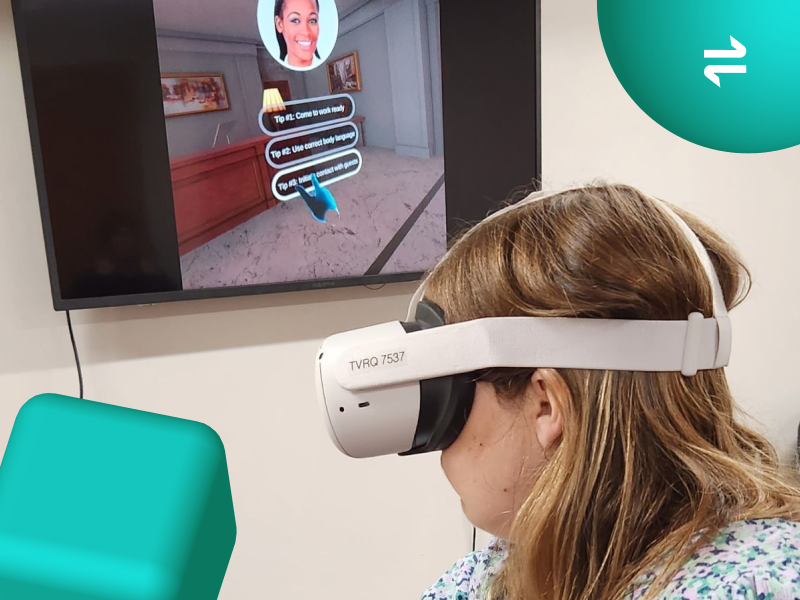
At Transfr, we saw the opposite firsthand when we joined Michael's team to bring a cohort of learners with visual impairments into virtual reality (read the Easterseals story). The learners stepped out of their headsets beaming: "That was pretty cool. That was great." It was a powerful reminder of how far opportunity can reach when we let learners show us what's possible for them.
Research shows how much expectations matter. A national study that followed 2,900 special education learners for six years after high school found that parents' expectations of employment were among the strongest predictors of competitive employment.
Raising expectations means handing learners the pen. Self-advocacy is a skill, and like any skill it grows with practice: learning to name what you need, explain how you work best, and speak up with confidence and professionalism. Small steps go a long way, like sharing a short "day-in-the-life" profile with an employer before an interview. A trait like avoiding eye contact, which an interviewer might otherwise misread, becomes part of a fuller picture of an extremely capable candidate.
When learners build their own career plans, with the careers they explored, what they loved, and the supports they need, they walk into IEP, 504, and IPE meetings as the authors of their futures, not the subjects of them. And their families leave with a concrete picture of what's possible.
Wall three: what employers assume
Our second panelist, Eric Black, President and CEO of MDI, runs a Minnesota plastics and packaging manufacturer where roughly half of its 500 employees are people with disabilities. He has heard the common assumptions, and he has the experience to answer them.
- "Accommodations are expensive." Many cost $500 or less.
- "It's a safety risk." At MDI, the injuries aren't happening among employees with disabilities. With good job fit, that part of the workforce is among the safest on the floor.
- "They'll stay in entry-level roles." One MDI employee moved from an entry-level job to process technician, one of the company's highest-paying roles, within 18 months. Then another followed. Then another.
Eric's advice to employers is simple: stop waiting to feel ready. "You actually have to get off the sidelines and start employing people, putting in those reps." And keep going: "The more individuals you employ, the stronger culture you build, the stronger the results." Confidence follows action. It doesn't come first.
The same principle applies to learners. Reps build confidence. The second and third try are often where it takes hold, which is why practice before a first placement matters so much.
How can Pre-ETS teams make every hour more impactful?
Since WIOA passed in 2014, Vocational Rehabilitation agencies have reserved at least 15% of their federal allotment for Pre-ETS, and an estimated 3.1 million learners with disabilities are eligible. The question is no longer whether Pre-ETS happens. It's whether those hours add up to something a learner can carry forward: a goal they chose, skills they've practiced, and the confidence to take the first step.
The programs getting there share a few habits:
- They design backward from a vocational goal, so the five required services work as a sequence, not a checklist.
- They let learners try before they decide, with short, low-stakes, repeatable practice.
- They meet learners wherever they are, including rural districts and juvenile justice settings.
- They build for every learner from the start, rather than accommodating after the fact.
This is where immersive learning earns its place. Work-based learning is irreplaceable, but placements are scarce, and learners often arrive without a chance to practice first. Simulations fill that gap. As Eric put it: "Dream it, see it, do it."
A partner that listens
Michael's closing advice to the audience wasn't about technology. It was about partnership: "It needs to be someone who listens."
That's the standard we hold ourselves to at Transfr. Closed captions, an improved stationary mode for seated use, one-handed options, casting, and prompts read aloud by a digital coach were all shaped by partner feedback.
Give possibility a next step
For someone supporting a young person's transition into adulthood, a moment of discovery can carry enormous meaning.
A learner asks about training for a career nobody had discussed with them. A family sees a new possibility. A learner finds the words to describe what they want and the support they need.
Our shared responsibility is to help those moments lead somewhere.
Transfr's Pathways to Possibility: A Practical Planning Guide for Vocational Rehabilitation Agencies and Pre-ETS Providers continues this conversation with research, practical approaches, and a team self-assessment to help connect exploration, experience, and learner-led planning.
Download the guide to explore how your team can help more learners discover a direction and take their next step toward it.
Missed the conversation? Watch the on-demand webinar on expanding employment pathways for people with disabilities with Michael Woolley (Easterseals Alabama), Eric Black (MDI), and Dan Risko (Transfr).