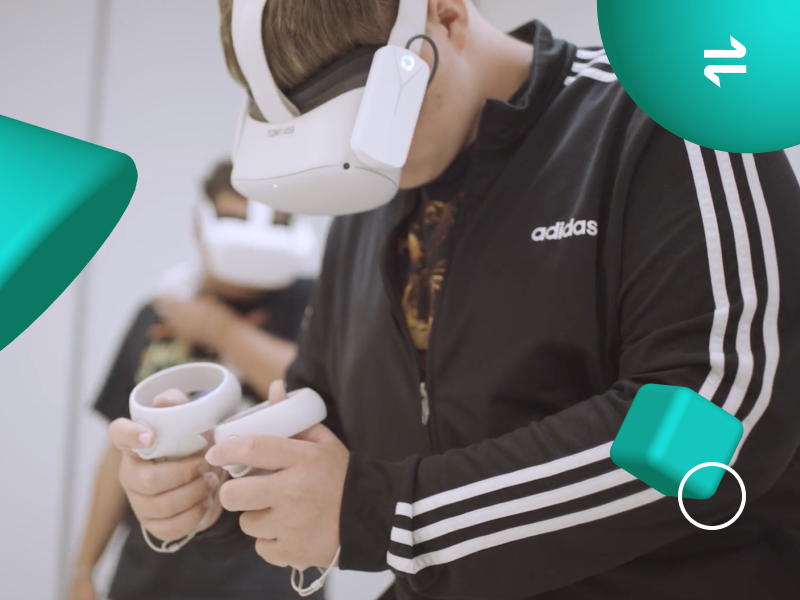
Virtual reality (VR) captures students’ attention the moment they put on a headset, surrounding them with sights and sounds that make learning feel like real-world discovery. K-12 schools are where the foundations of future career success are built. Through a variety of career exploration activities, combined with guidance from instructors and counselors, and innovative CTE programs, young learners can build their own unique pathways to career success.
VR equips students with new ways to explore career options—especially careers that don’t require a four-year degree. Instead of just reading or watching videos, learners can step inside real workplaces and see what the job is actually like.
With VR, students can:
- Explore careers firsthand by experiencing a day in the life of different occupations
- Practice real skills safely through hands-on simulations
- Build confidence as they develop job-ready skills
- Discover new career interests through immersive experiences
Transfr simulations allow students to explore a variety of real-world work environments, including:
- An automotive shop, where they can safely learn how to work on cars
- The top of a communication tower, where they practice installing broadband
- A city center, where they repair fiber cable to restore internet service
The possibilities are endless. And with new simulations released every few months, students don’t just learn about careers—they experience them, all without leaving the classroom.
VR keeps K-12 Students Engaged
Not every young student is interested in the latest technology, but VR often captures their imaginations. It’s not uncommon to hear that students who aren’t very interested in career education change their behavior when presented with the opportunity to investigate different jobs in VR.
“Students LOVE Transfr VR,” says Sarah Jane Walker, CTE Counselor at Tyler Independent School District in Texas. “When I arrive at school with our headsets, I get a cheer from the class. It’s something students really look forward to!”
Job markets in the US are evolving rapidly and students are often unaware of the career options available to them or how to secure these well-paying jobs in high-growth industries. While guest speakers and field trips to work sites are compelling experiences, they can be expensive and difficult to scale. Immersive VR career exploration brings the workplace to the school — even in fields that students might not be very knowledgeable about.
“Transfr allows students to explore lots of different occupations to get them to think outside of the box,” says Diana Ollis, a Career Development Coordinator a Union County Public School in North Carolina. “Students need to realize that there are lots of opportunities out there, not just what you see in the community at home.”
West Alabama Works takes Transfr headsets on the road for their Worlds of Work events, giving 8th and 9th graders a chance to dig into VR experiences of an array of occupations. These events boosted CTE enrollment by almost 20% when they were initially rolled out. In West Virginia, Workforce Development Board Mid-Ohio Valley’s summer CTE Explore Camp takes 9th and 10th graders through a week of career exploration activities, including VR time. Again, VR has huge potential to give students insights into careers they may not have considered:
“I like showing people how to use the VR to try jobs they wouldn’t have an opportunity to do otherwise,” says Russell Spencer, a VR Tech who helped facilitate the camp. “This allows them to experience jobs without needing access to the costly real equipment or having to travel to where the equipment is.”
VR skills training helps schools teach complex, hands-on skills in a way that is safer, more engaging, and more cost-effective.
VR Skills Training Improves Safety and Lowers Costs
With VR, students can start building skills right away—without the risks or costs of real-world equipment.
VR skills training helps schools:
- Keep students safe while they learn high-risk skills
- Reduce costs by eliminating wear and tear on equipment
- Introduce complex tasks without needing a physical lab
- Engage students immediately, instead of relying on long lectures
According to Keith Lyle, PhD, Transfr’s Director of Learning Sciences, VR learning creates what he calls “the joy of doing.”
“This joyful reaction seems to be driven in part by how easily the simulations capture the learner’s attention.”
Built-in safety for every learner
Safety is one of VR’s biggest advantages—especially for K–12 students. Learning skilled trades often involves risk, but VR allows students to:
- Practice core job skills in a risk-free environment
- Learn proper safety procedures before working with real tools
- Build confidence without the fear of injury
As Johnnie Parker, a veteran electrician and instructor, explains:
“Technology has evolved. Today’s students have new options that can keep them safer as they develop the skills they’ll need in the field.”
Real skills, without real-world risk
In VR, students can safely:
- Work on cars and other vehicles
- Handle dangerous or expensive materials
- Practice using flames, sharp tools, and heavy equipment
A virtual coach guides learners through each step, offering reminders and reinforcing proper safety practices. While mistakes are risk-free in VR, the skills and habits carry over into the real world.
Supporting Instructors, Not Replacing Them
VR doesn’t replace educators or hands-on, real-world training. Instead, it enhances instruction by:
- Providing calm, consistent coaching during every session
- Allowing instructors to give more one-on-one support
- Adding a powerful new tool to prepare students for the workforce
Together, VR and human instruction create a safer, more effective path from learning to doing.
VR Training Builds Hope for Students’ Futures
A growing body of research is showing time and time again that VR opens a whole new world of possibilities, helping students picture futures they may never have imagined. Yes, they enjoy the headsets— but beyond the excitement, these experiences empower them to dream bigger and plan concrete next steps.
Living in an increasingly complex world of mounting uncertainty, it’s natural for young people to wonder what their futures will look like. Instructors, counselors, and trade professionals need to be realistic with young learners about the challenges they’ll face. That being said, there are amazing opportunities out there for the coming generations in a variety of fields, especially trades that don’t require a university degree to get started.
Time spent in VR, coupled with meaningful conversations with professionals and educators, can help students plan effective career pathways towards well-paying jobs in high-growth industries. It can also give them the spark they need to the steps they need to take to turn this plan into reality:
“Something we talk about at Transfr is how these experiences give learners hope,” says Amanda Longtain, Director of Programs at Transfr. “Even though hope is hard to measure, it's literally what pushes us forward.”
Learn How Transfr Can Bring the Future of Learning to Your School
FAQs
How can VR help K-12 students explore careers? VR helps K–12 students explore careers by immersing them in realistic, hands-on simulations of real-world jobs they may not otherwise experience. Through guided VR experiences, students can safely try tasks, understand workplace environments, and connect classroom learning to future career pathways—building awareness, confidence, and motivation early.
Is VR safe for kids to use in class? Yes, VR can be safe for kids when it is designed specifically for classroom use and implemented with age-appropriate guidelines. Educational VR platforms like Transfr are built for supervised learning, short session lengths, and curriculum alignment, helping schools provide engaging career exploration expe
What equipment does a school need to start VR lessons? To start VR lessons, a school typically needs VR headsets, a compatible device or management system, and access to an educational VR platform. Solutions like Transfr are designed for classroom use, with straightforward setup and tools that allow educators to easily manage lessons and guide students through immersive learning experiences.